Welcome
The European Cultural Studies Network (ECSN) is a growing network of scholars and institutions dedicated to the development of research, innovation, training and dissemination in the field of Cultural Studies.
Born from the Portuguese National Network in Cultural Studies (RNEC), founded in 2021, the ECSN was formally established in 2025 at the IV NNCS Congress in Lisbon. We bring together researchers working across arts, gender, performance, communication, postcolonial studies, activism, leisure, cultural industries, globalisation, identities and migratory movements.
This is a highly interdisciplinary field, characterised by intense theoretical debate and, at the same time, a particular focus on the concrete and empirical context, as it engages with the current practices of contemporary societies, rooted in their own history.
The European Cultural Studies Network aims to promote the structuring of the field and to encourage cooperation, in order to strengthen scientific output in the area, as well as to disseminate it through links with other networks.
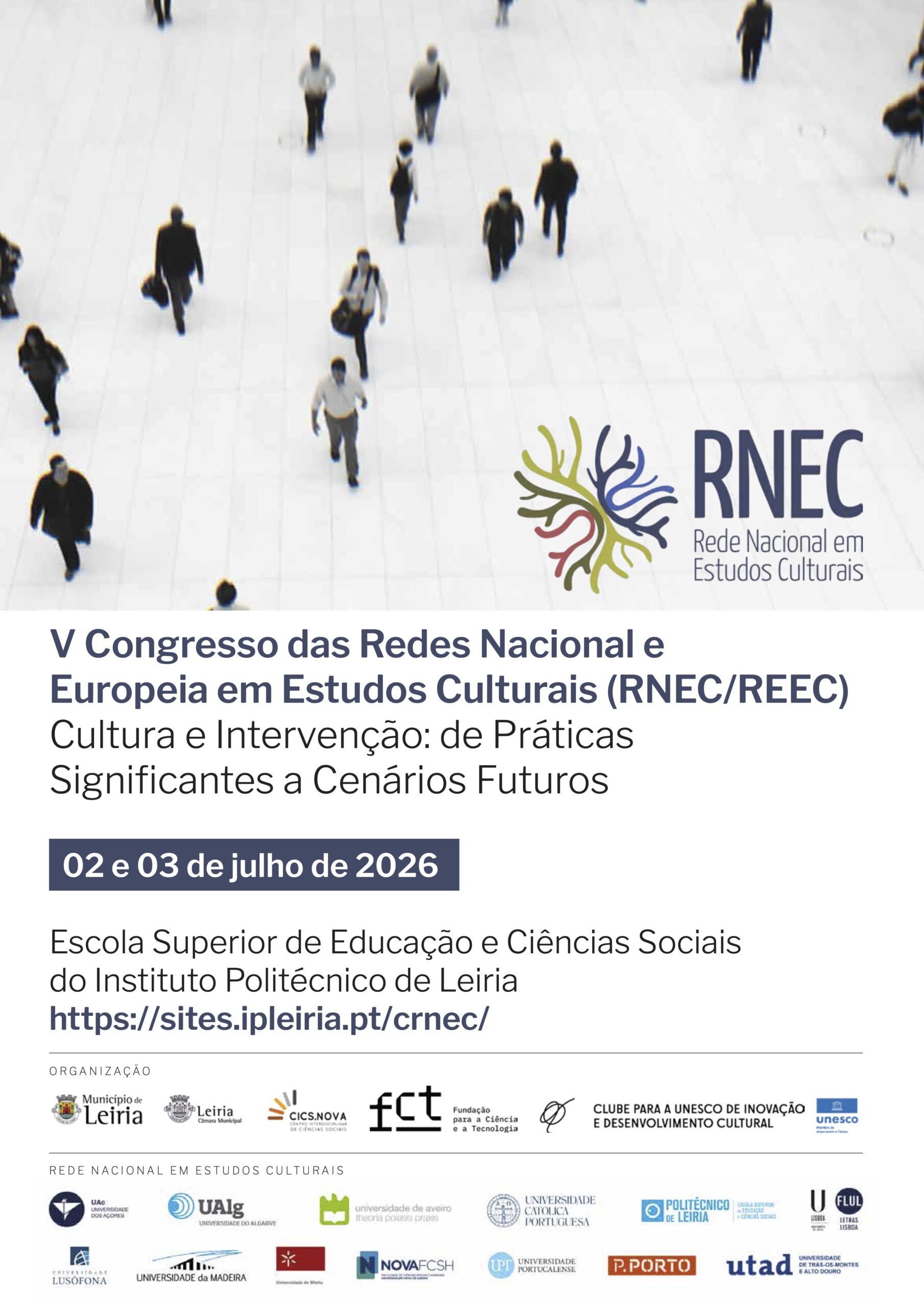
5th Congress of the National and European Networks in Cultural Studies (NNCS/ECSN)
Culture and Intervention: From Signifying Practices to Future ScenarioThe V Congress of the National Network in Cultural Studies (RNEC) proposes a space for critical reflection on the cultural practices that shape the present and future horizons. Under the theme “Culture and Intervention: from Signifying Practices to Future Scenarios,” the meeting invites researchers, artists, lecturers, students and cultural practitioners to debate the ways in which culture acts, intervenes and projects social transformations.


Mission Statement
At a time when Europe faces profound challenges, such as rising inequalities, democratic fragmentation, climate crisis, migration, and struggles over identity and belonging, Cultural Studies offers essential tools for understanding and intervention. The European Cultural Studies Network connects researchers, institutions, and ideas across borders, fostering critical scholarship.
The relevance of the field has proven to be even more evident in a time of contemporary algorithmic culture that transforms social life by turning humans into computable matter and the establishment of a digital world that is not neutral tool, but as a pervasive environment that requires the Social Sciences and Humanities to provide analytical judgment and a critical perspective.
Members




who we are
The European Cultural Studies Network (ECSN) is a transnational academic network dedicated to research, teaching, and the dissemination of Cultural Studies across Europe. We work in the broad, interdisciplinary tradition attentive to questions of power, identity, representation, and social change. Our members engage with topics ranging from gender and postcolonial critique to media, performance, leisure, migration, and cultural industries. The ECSN emerged from the Portuguese National Network in Cultural Studies (RNEC), which since 2021 has brought together researchers and institutions across Portugal. In 2025, at the IV RNEC Congress held at Universidade Lusófona in Lisbon, the network expanded its scope and was formally transformed into the ECSN — opening its doors to institutions and scholars throughout Europe. Today, the ECSN connects members from Portugal, Spain, the United Kingdom, the Netherlands, Switzerland, Italy, Bulgaria, and Poland, with the ambition to grow further.
What We Do
- Foster collaboration through joint research projects, publications, and events
- Organise an annual congress, hosted on a rotating basis by member institutions
- Hold biannual online meetings to coordinate activities and share work in progress
- Provide a platform for visibility and exchange among Cultural Studies scholars across Europe
- Support early-career researchers and promote doctoral training in the field
Cultural Studies, as practised within this network, draws on the intellectual legacy rooted in the idea that culture is a site of power, contestation, and possibility. We carry forward their commitment to interdisciplinarity, critical engagement, and attention to the lived experiences of ordinary people. This does not mean exclusion: we welcome diverse theoretical approaches and methodological traditions. What unites us is a shared conviction that scholarship should matter — that it should illuminate, challenge, and contribute to more just societies.